
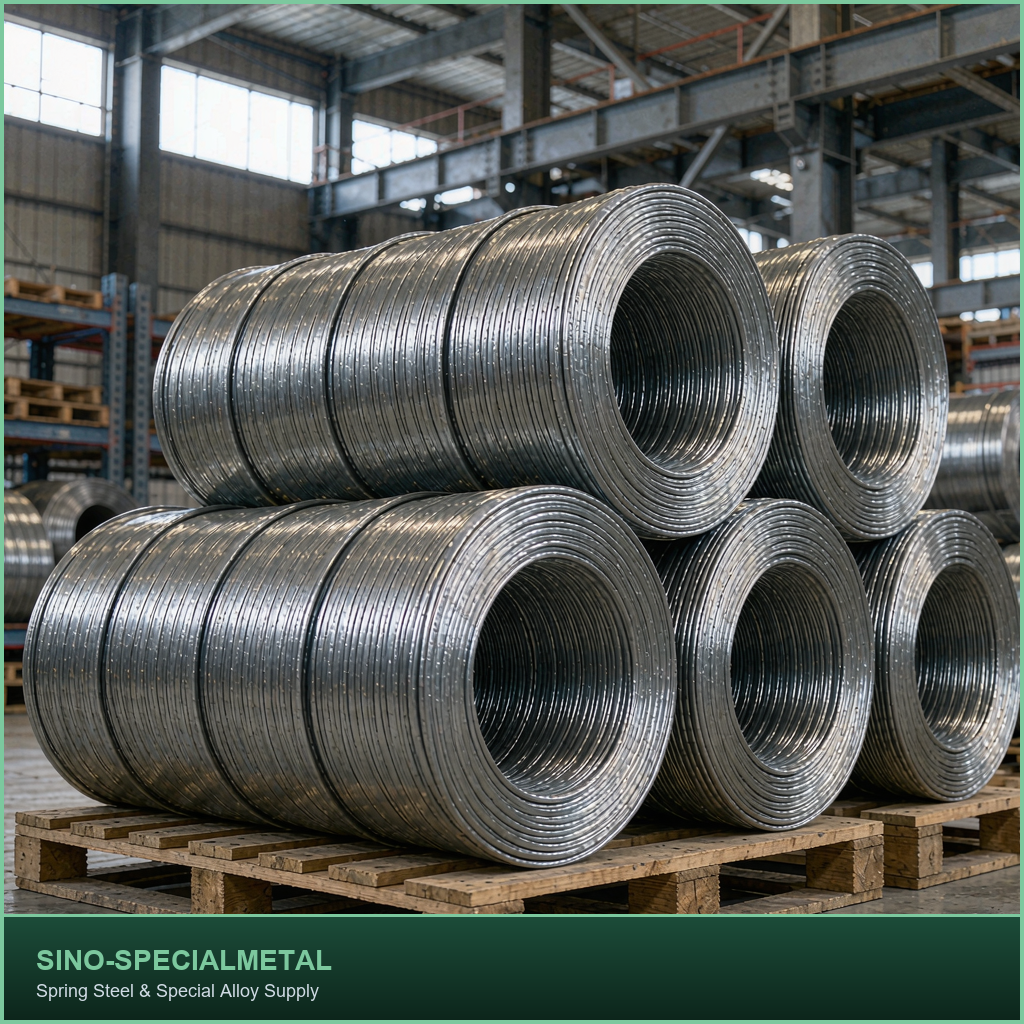
A high-manganese carbon spring steel supplied as wire, strip, plate and bar. It hardens more deeply than plain 1060, keeps a reliable set after tempering, and stays one of the most cost-effective choices for leaf springs, clips and saw blades.
What Is 65Mn Spring Steel?
65Mn is a plain carbon spring steel with about 0.65% carbon and roughly 1% manganese. The manganese does two jobs: it drives carbon deeper into the section during quenching, and it nudges up the strength of the ferrite. For a spring maker the practical result is simple — 65Mn strip and wire through-harden in oil, where a plain 1060 would need a water quench and would crack far more often.
It is the workhorse grade in China for light-vehicle leaf springs, spring washers, clutch parts, band saw blades and measuring tapes. It is not a high-alloy steel and it is not stainless: any part that sees rain, salt or humidity should be oiled, coated or phosphated.
Supply Forms and Sizes
Every form is available annealed (for further forming and machining) or hardened and tempered to your hardness window.
| Form | Condition | Size Range | Typical Use |
|---|---|---|---|
| Cold-drawn wire | Annealed / oil-tempered | 0.1 – 13 mm diameter | Small coil springs, clips, tire bead wire |
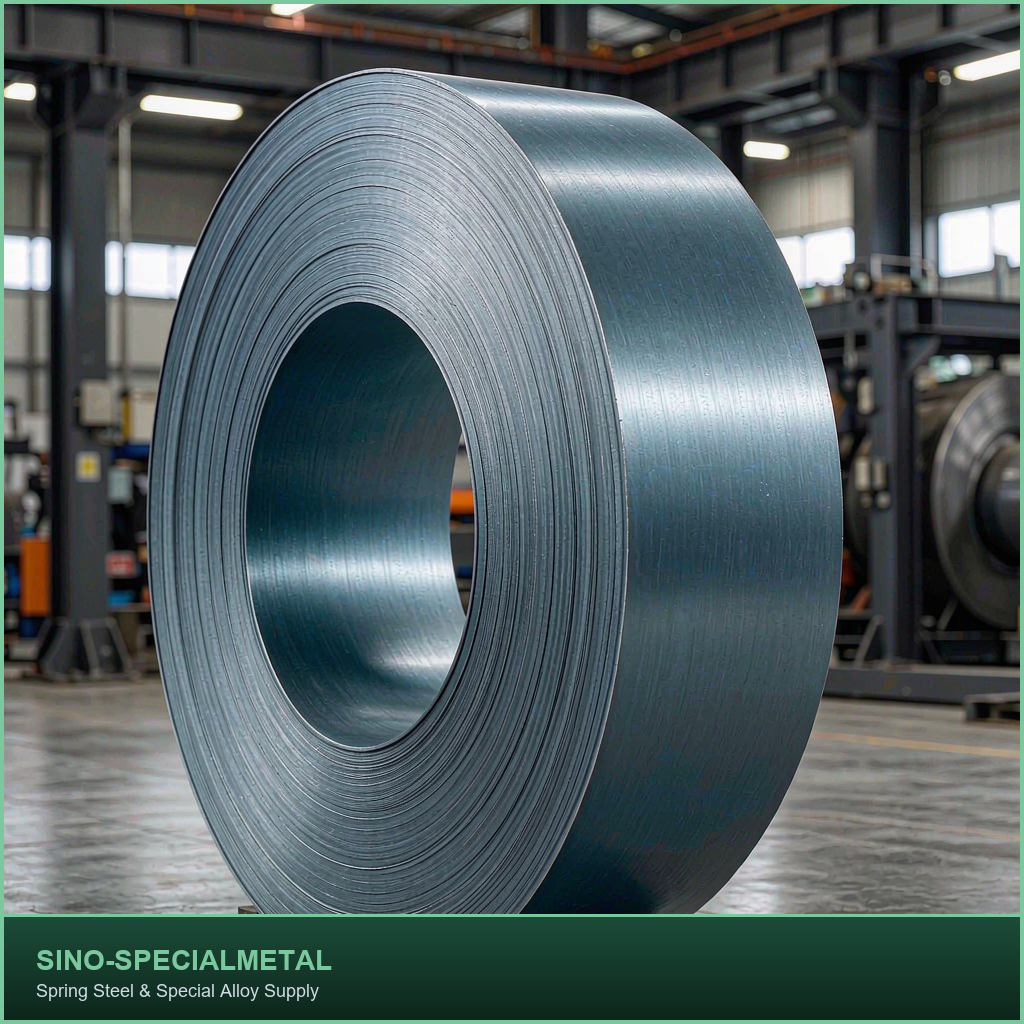
| Hardened & tempered strip | Q&T, edge dressed | 0.1 – 4 mm thick, width to 600 mm | Spring washers, saw blades, measuring tapes |
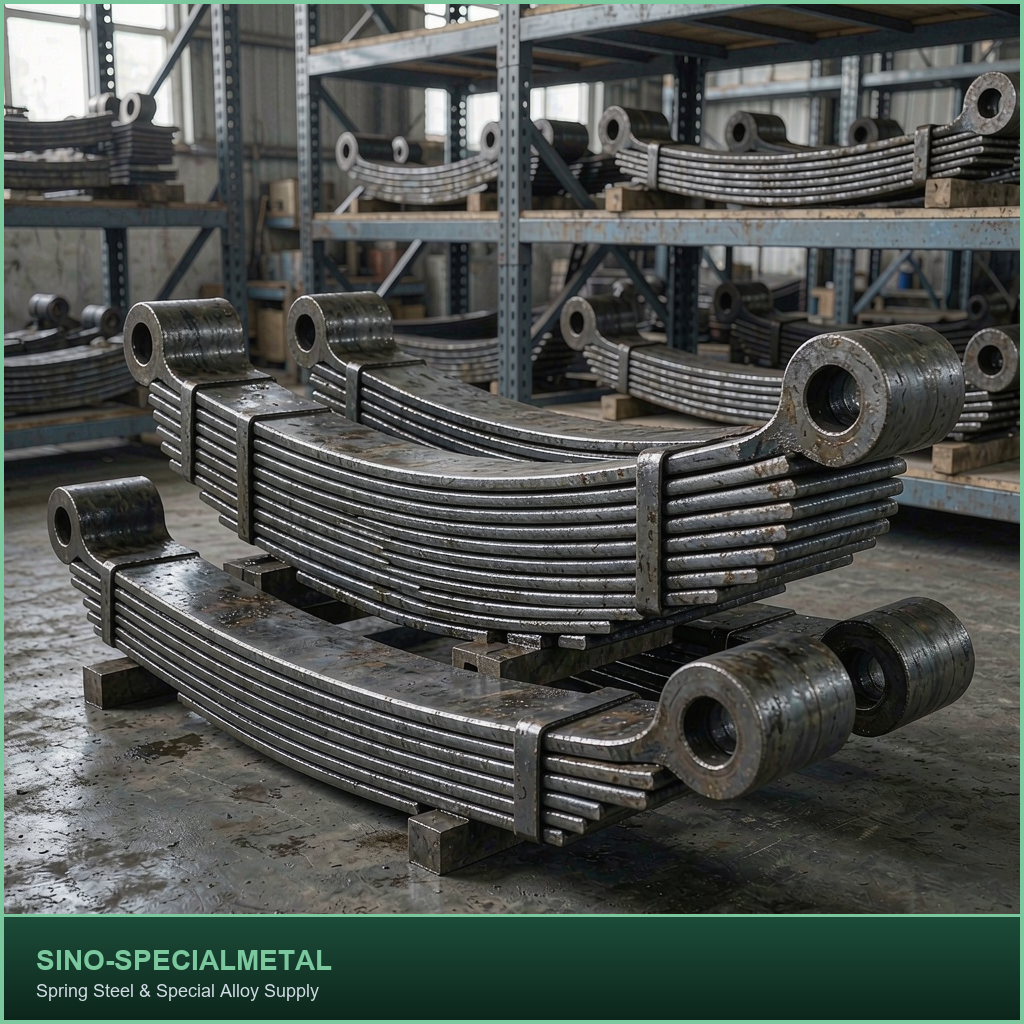
| Hot-rolled plate | Hot rolled / normalized | 3 – 60 mm thick | Leaf springs, wear plates |
| Round / flat bar | Hot rolled / cold drawn | 10 – 120 mm | Forged springs, machined parts |
Chemical Composition (GB/T 1222)
| C | Si | Mn | P max | S max | Cr max | Ni max | Cu max |
|---|---|---|---|---|---|---|---|
| 0.62 – 0.70 | 0.17 – 0.37 | 0.90 – 1.20 | 0.035 | 0.035 | 0.25 | 0.30 | 0.25 |
Heat analysis is reported on the mill certificate for every heat lot. If your drawing calls for tighter sulfur or phosphorus than the standard, flag it at enquiry stage — ladle-refined heats usually meet it without a surcharge.
Physical Properties
| Property | Value |
|---|---|
| Density | 7.85 g/cm³ |
| Elastic modulus (E) | ~200 GPa |
| Shear modulus (G) | ~79 GPa |
| Thermal conductivity | ~45 W/m·K at room temperature |
| Coefficient of thermal expansion | ~11.5 ×10⁻₆ /K (20 – 100 °C) |
Mechanical Properties
Values below are typical for 65Mn after oil quenching from 810 to 830 °C and tempering near 450 °C. Exact numbers shift with section size and tempering temperature; the mill certificate is the binding document.
| Condition | Tensile Strength | Yield Strength | Elongation | Hardness |
|---|---|---|---|---|
| Hot rolled, annealed | ≥ 735 MPa | ≥ 430 MPa | ≥ 9 % | ≤ 269 HB |
| Quenched & tempered | 980 – 1270 MPa | ≥ 785 MPa | ≥ 8 % | 38 – 50 HRC |
| Oil-tempered wire | 1500 – 1900 MPa | — | — | per size class |
Equivalent Grades
| Standard | Designation |
|---|---|
| China GB/T 1222 | 65Mn |
| USA AISI / SAE | 1566 |
| Japan JIS G4801 | SUP9 (similar) |
| Germany DIN | 65Mn4 (similar) |
| ISO | SPM-type Mn spring steels |
Heat Treatment and Processing
Heat slowly to ~800 °C, then up to 1050 – 1100 °C. Work above 850 °C and slow-cool after forging.
780 – 840 °C, soak, then furnace cool at ≤ 20 °C/h. Delivers ≤ 269 HB for forming and machining.
810 – 830 °C, oil. Thin strip may be austempered where distortion matters.
350 – 550 °C by required hardness; ~450 °C gives the usual spring window of 40 – 45 HRC.
Formed springs: 250 – 350 °C, 30 – 60 min, air cool — after coiling or bending, before finish sizing.
One caution from the shop floor: decarburized surface layers kill fatigue life in spring strip. We control decarb depth per GB/T 224 on strip orders and can supply decarb-free (ground) strip for high-cycle springs.
Applications of 65Mn
The classic use. Hot-rolled plate is cut, punched, cambered and heat treated; 65Mn carries the stroke loads at low cost.
Hardened-and-tempered strip keeps a consistent set after stamping; 40 – 46 HRC is typical.
Strip at 44 – 50 HRC takes and holds an edge; the Mn addition keeps thin sections from cracking in quench.
Oil-tempered wire gives the fatigue life needed at moderate temperature and price.
Thin strip with tight thickness tolerance and controlled decarb for a uniform temper colour.
S-tines and sweeps from 65Mn bar survive stony soil better than plain medium-carbon grades.
65Mn vs Alternative Grades
| Grade | vs 65Mn | Choose It When |
|---|---|---|
| 65Mn | — | Cost matters and sections are small-to-medium; the workhorse for strip, wire and light leaf springs. |
| 60Si2MnA | Higher Si raises elastic limit and heat resistance | Heavier leaf springs or higher stress than 65Mn is rated for. |
| 50CrV4 | Cr+V improves toughness, fatigue and temper resistance | High-cycle valve springs, or parts running above ~120 °C. |
| SUP9 / 55Cr3 | Higher hardenability for thick sections | Heavy-vehicle leaf springs where oil quench must fully harden 20 mm+ plate. |
Quality Control and Mill Certificates
Every shipment ships with an EN 10204 3.1 mill certificate covering heat chemical analysis, hardness and the mechanical test on record. On request we add: decarburization depth report (GB/T 224), spheroidizing rating for wire-drawing lots, ultrasonic test on plate above 20 mm, and third-party inspection (SGS / BV) before loading.
Frequently Asked Questions
What is 65Mn spring steel equivalent to?
Nominally AISI/SAE 1566; also close to JIS SUP9 and DIN 65Mn4. Similar but not identical chemistries — confirm against the mill certificate for critical parts.
Can 65Mn be hardened?
Yes — oil quench from 810 to 830 °C, then temper at 350 to 550 °C. Working hardness lands between 38 and 50 HRC depending on temper.
What is the difference between 65Mn and 1060?
The manganese. 0.90 – 1.20% Mn in 65Mn lifts hardenability, so thin strip hardens fully in oil where 1060 needs water and cracks more easily.
Is 65Mn good for knives and saw blades?
Widely used for band saw blades and knives — good edge, tough enough to resist chipping. It will rust, so keep it oiled or coated.
What is the minimum order quantity?
Mill lots typically start at 500 kg per item; trial quantities of wire and strip are often available from stock. Ask us — we confirm cost and delivery within 24 hours.
Related Products
A2 Tool Steel
High-Speed Steel
Spring Steel Wire
Spring Steel Strip
Spring Steel Plate
Spring Steel Bar
50CrV4 Spring Steel
SUP9 Spring Steel
60Si2MnA Spring Steel
Send your form, size, condition (annealed or Q&T), quantity and destination port. You will get a firm price and lead time within one working day.