
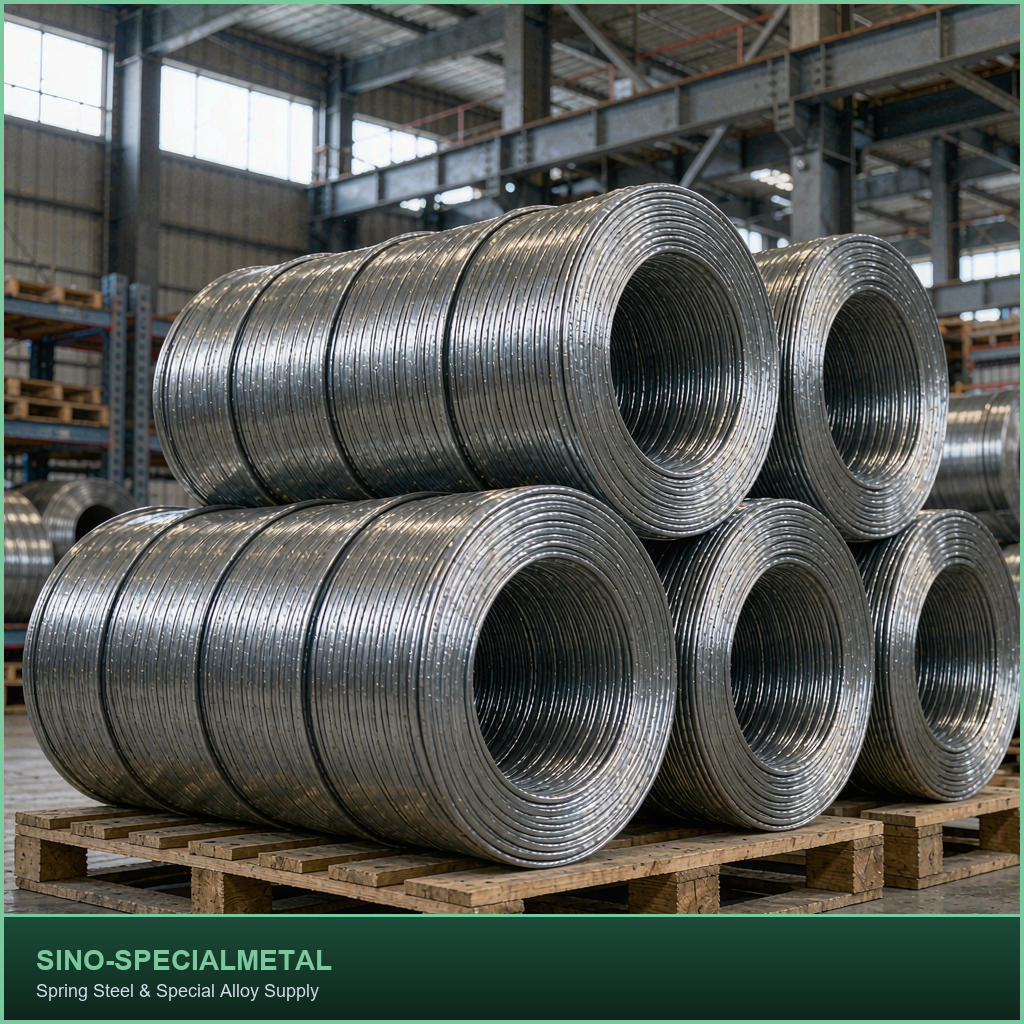
A Japanese chromium spring steel (JIS G4801) in the 55Cr3 family. SUP9 hardens deeply enough to fully oil-quench thick leaf-spring plate, which is why it is the standard grade for heavy-vehicle and railway suspension.
What Is SUP9 Spring Steel?
SUP9 is the JIS designation for a 0.6% carbon chromium spring steel, closely matching European 55Cr3. The chromium lifts hardenability so plate 20 mm and thicker through-hardens in oil — essential for heavy leaf springs that must carry full load across the section.
It is specified across truck, trailer and railway suspension. It costs more than plain carbon 65Mn but earns it where section size and fatigue matter. It is not stainless and needs protection in corrosive service.
Supply Forms and Sizes
Every form is available soft-annealed (for further forming and machining) or heat-treated to your hardness window.
| Form | Condition | Size Range | Typical Use |
|---|---|---|---|
| Hot-rolled plate | Hot rolled / normalized | 3 – 60 mm | Leaf springs, wear plates |
| Hot-rolled bar | Hot rolled / cold drawn | 10 – 120 mm | Forged springs, machined parts |
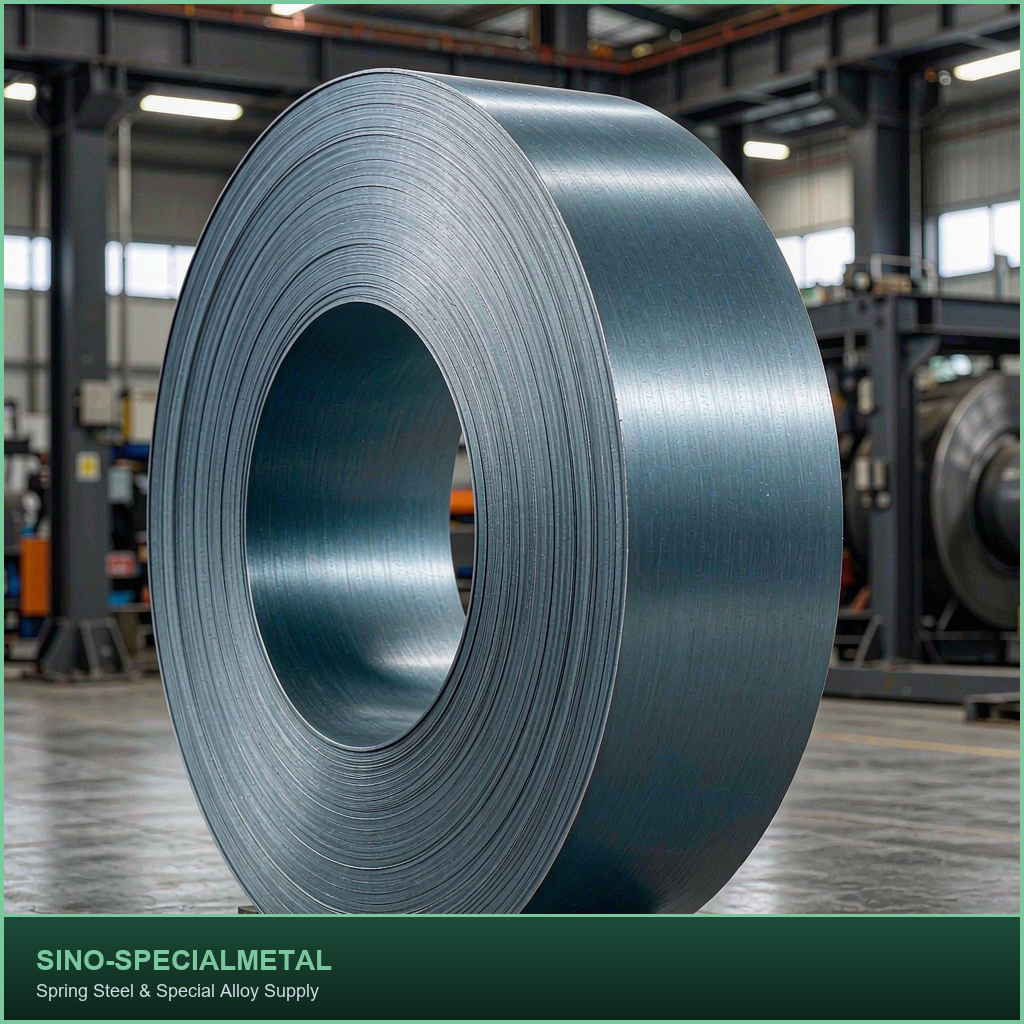
| Hardened & tempered strip | Q&T | 0.5 – 8 mm | Heavy washers, blades |
| Cold-drawn wire | Annealed / oil-tempered | 1 – 14 mm | Coil springs |
Chemical Composition (JIS G4801 (SUP9))
| C | Si | Mn | Cr | P max | S max |
|---|---|---|---|---|---|
| 0.55 – 0.65 | 0.15 – 0.35 | 0.65 – 0.95 | 0.65 – 0.95 | 0.030 | 0.030 |
Heat analysis is reported on the mill certificate for every lot. If your drawing calls for tighter limits than the standard, flag it at enquiry — ladle-refined heats usually meet it without a surcharge.
Physical Properties
| Property | Value |
|---|---|
| Density | 7.85 g/cm³ |
| Elastic modulus (E) | ~200 GPa |
| Shear modulus (G) | ~79 GPa |
| Thermal conductivity | ~40 W/m·K at room temperature |
| Coefficient of thermal expansion | ~12 ×10⁻₆ /K (20 – 200 °C) |
Mechanical Properties
Typical values for SUP9 after oil quenching and tempering near 480 °C. The mill certificate is the binding document.
| Condition | Tensile Strength | Yield Strength | Elongation | Hardness |
|---|---|---|---|---|
| Hot rolled, annealed | ≥ 1080 MPa | ≥ 930 MPa | ≥ 10 % | ≤ 321 HB |
| Q&T | 1220 – 1470 MPa | ≥ 1070 MPa | ≥ 8 % | 40 – 49 HRC |
| Oil-tempered wire | 1500 – 1900 MPa | — | — | per size class |
Equivalent Grades
| Standard | Designation |
|---|---|
| Japan JIS G4801 | SUP9 |
| Europe EN | 55Cr3 (similar) |
| USA AISI / SAE | 5160 / 5155 (similar) |
| China GB/T 1222 | 55Cr3 (similar) |
Heat Treatment and Processing
Preheat slowly, then raise to the grade forging range. Work above the lower limit and cool slowly after forging to avoid cracks.
780 – 840 °C, soak, furnace cool. Soft condition for forming and machining.
830 – 860 °C, oil. Full hardenability for thick plate.
400 – 540 °C by required hardness; ~480 °C gives the usual 44 – 49 HRC leaf-spring window.
After machining or forming, 200 – 350 °C for 1 – 2 hours, air cool, to stabilise dimensions and relieve residual stress.
Heat-treated bars and plates are supplied with the hardness and test certificate you specify. For critical parts we can control decarburisation depth and supply a spheroidized or soft-annealed structure on request.
Applications of SUP9 Spring Steel
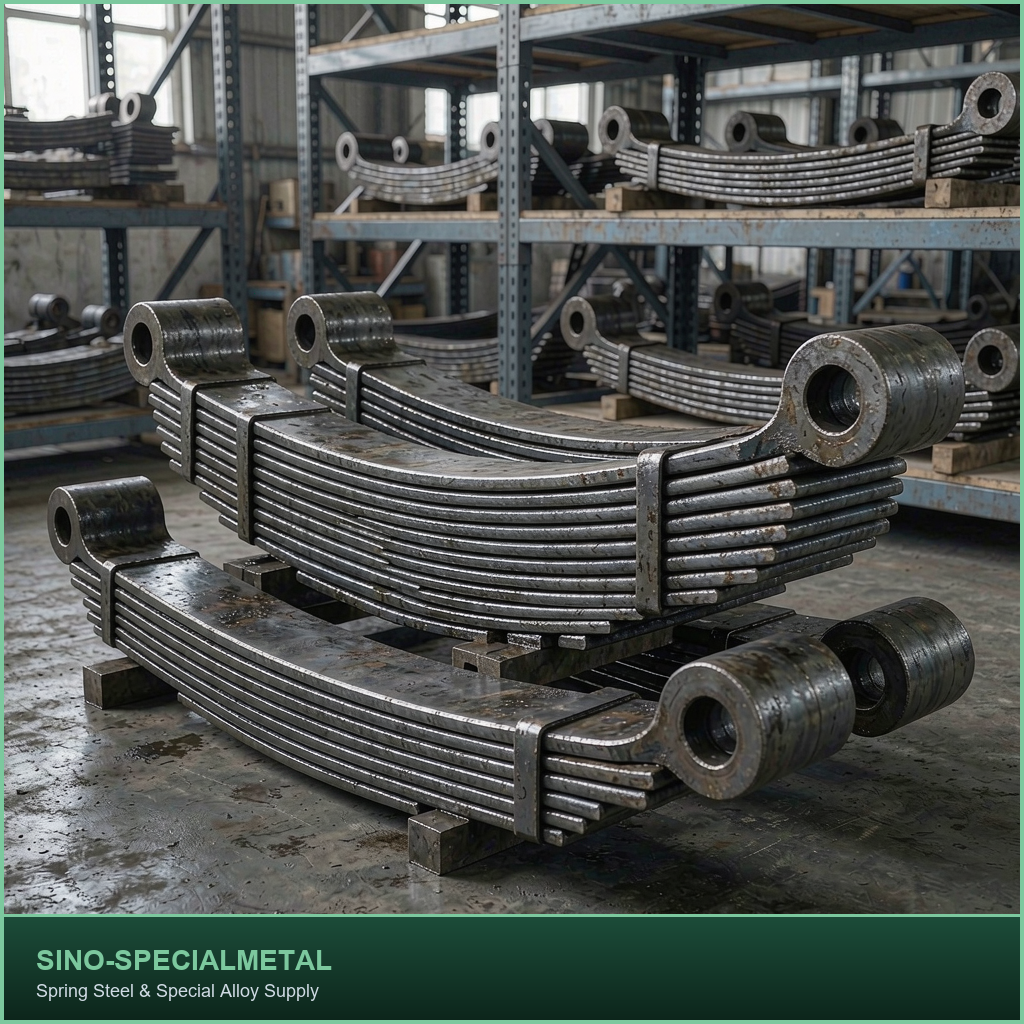
The main use — trucks, trailers and buses rely on SUP9 plate.
Thick sections that must through-harden in oil.
Suspension and buffer springs for commercial vehicles.
Tines, sweeps and linkage springs in abrasive duty.
Hardened-and-tempered strip at 44 – 49 HRC.
From SUP9 bar, for high-load machined springs.
SUP9 Spring Steel vs Alternative Grades
| Grade | vs SUP9 Spring Steel | Choose It When |
|---|---|---|
| SUP9 | — | Thick leaf and coil springs needing oil through-hardening. |
| 65Mn | Cheaper, lower hardenability | Light leaf, strip and wire springs |
| 50CrV4 | Adds V for fatigue and temper resistance | High-cycle or warm engine springs |
| 9260 (Si-Mn) | Higher Si, very high elastic limit | Large leaf springs at lower cost |
Quality Control and Mill Certificates
Every shipment ships with an EN 10204 3.1 mill certificate covering heat chemical analysis, hardness and the mechanical test on record. On request we add: ultrasonic test on heavy bar and plate, magnetic particle inspection on machined surfaces, and third-party inspection (SGS / BV) before loading. Dimensional tolerances follow the relevant EN / ASTM / JIS standard or your drawing.
Frequently Asked Questions
What is SUP9 equivalent to?
AISI 5160 / 5155 and European 55Cr3 are close; China GB 55Cr3 is similar. Confirm against the certificate for critical parts.
Is SUP9 good for leaf springs?
Yes — its chromium gives the hardenability to fully oil-quench thick plate, which is exactly what heavy leaf springs need.
What hardness does SUP9 reach?
Typically 40 – 49 HRC in the quenched-and-tempered condition.
SUP9 vs 65Mn?
SUP9 hardens thicker sections and lasts longer under load, at higher cost; 65Mn suits light, low-cost springs.
What is the minimum order quantity?
Mill lots typically start at 500 kg per item; trial plate and bar are often from stock.
Related Products
Send your form, size, condition, quantity and destination port. You will get a firm price and lead time within one working day.