
Austenitic stainless spring steels (AISI 301 / 302) for springs, clips and retainers that must resist corrosion and stay springy after cold forming. 301 work-hardens fast and reaches very high strength; 302 is the general grade. Supplied as cold-rolled strip and wire.
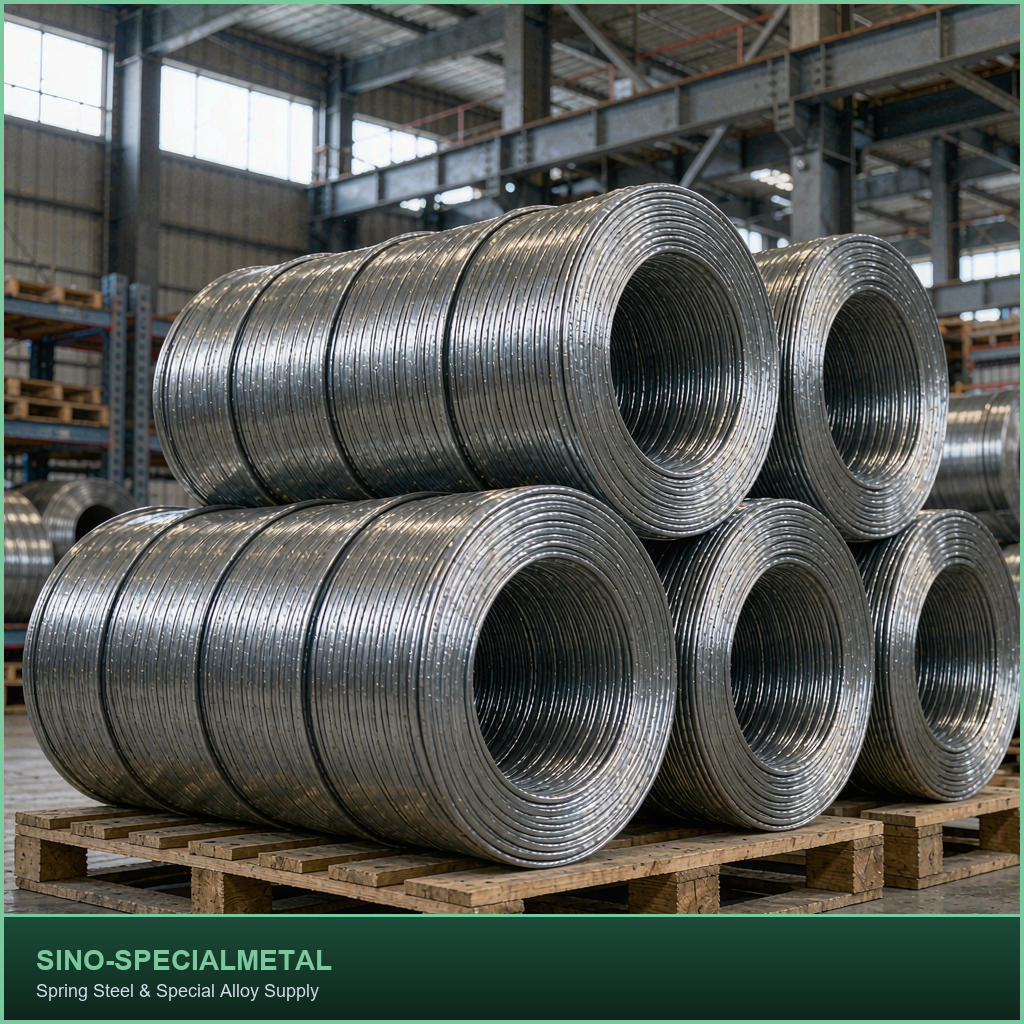
What Is 301 / 302 Stainless Spring Steel?
301 and 302 are 18-8 austenitic stainless steels. They are not quench-hardened; instead they are cold-rolled to tempers (1/2H, 3/4H, full hard, spring temper) that build the strength a spring needs while keeping the metal formable in the soft state.
301 gains strength much faster than 302 as it is cold worked, so it is the first choice for high-strength stainless springs. Both resist most atmospheres, food and many chemicals — far better than carbon spring steels in corrosive service.
Supply Forms and Sizes
Every form is available soft-annealed (for further forming and machining) or heat-treated to your hardness window.
| Form | Condition | Size Range | Typical Use |
|---|---|---|---|
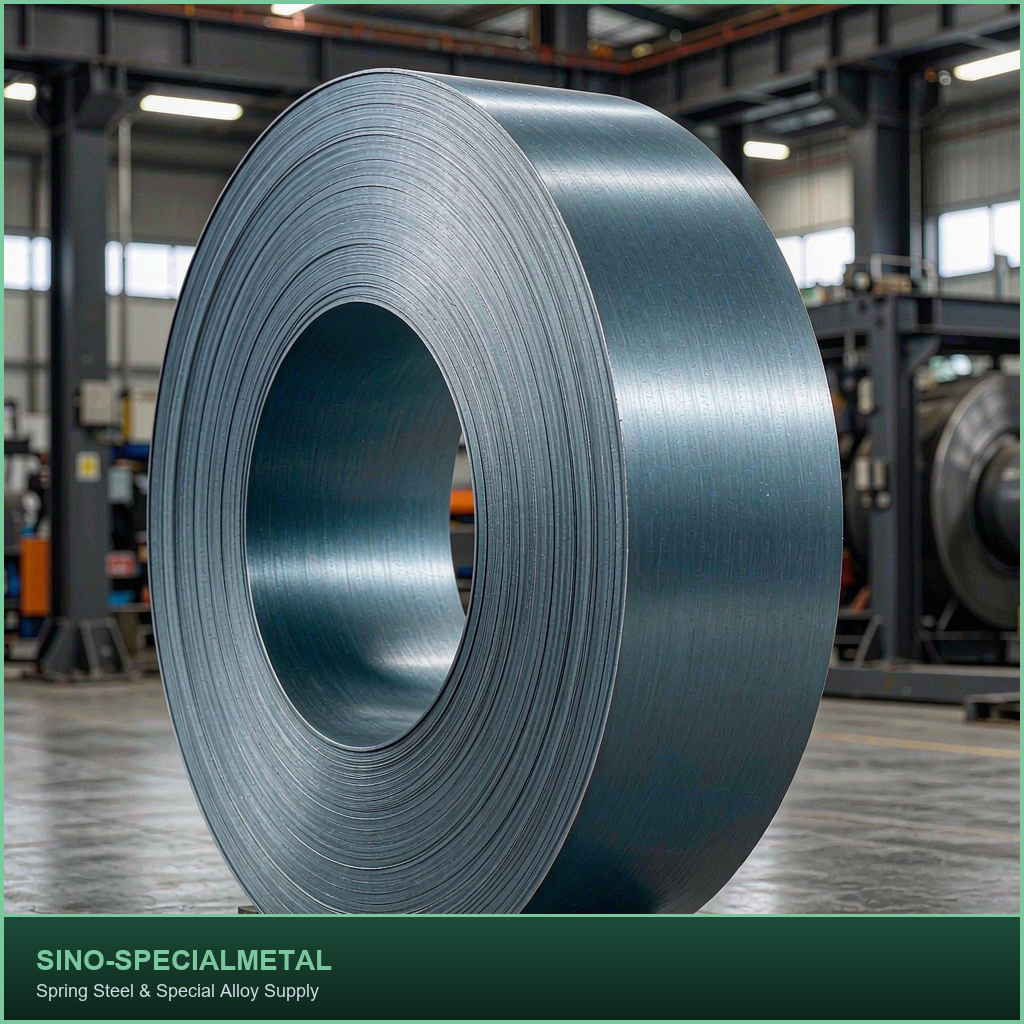
| Cold-rolled strip | 1/2H – Spring temper | 0.05 – 3 mm | Clips, springs, washers |
| Cold-drawn wire | 1/2H – Spring temper | 0.1 – 8 mm | Coil springs, retainers |
| Sheet | Annealed / 1/2H | 0.3 – 6 mm | Stamps, shims |
| Foil | Spring temper | 0.02 – 0.5 mm | Electronic springs |
Chemical Composition (AISI 301 / 302)
| C max | Mn max | Si max | Cr | Ni | P max | S max |
|---|---|---|---|---|---|---|
| 0.15 | 2.00 | 1.00 | 17.0 – 19.0 | 8.0 – 10.0 | 0.045 | 0.030 |
Heat analysis is reported on the mill certificate for every lot. If your drawing calls for tighter limits than the standard, flag it at enquiry — ladle-refined heats usually meet it without a surcharge.
Physical Properties
| Property | Value |
|---|---|
| Density | 7.85 g/cm³ |
| Elastic modulus (E) | ~200 GPa |
| Shear modulus (G) | ~79 GPa |
| Thermal conductivity | ~40 W/m·K at room temperature |
| Coefficient of thermal expansion | ~12 ×10⁻₆ /K (20 – 200 °C) |
Mechanical Properties
Typical tensile values by temper for cold-rolled strip. Stainless springs are cold-worked, not quench-tempered; the mill certificate is the binding document.
| Condition | Tensile Strength | Notes |
|---|---|---|
| Annealed | ~515 – 620 MPa | Soft, for forming |
| 1/2 Hard | ~860 – 1030 MPa | Moderate springs |
| 3/4 Hard | ~1030 – 1205 MPa | General springs |
| Full Hard | ~1275 – 1470 MPa | Strong springs |
| Spring Temper (EH) | ~1600 – 1750 MPa | Max strength |
Equivalent Grades
| Standard | Designation |
|---|---|
| USA AISI | 301 / 302 |
| Europe EN | 1.4310 (301) / 1.4301 (302) |
| Japan JIS G4303 | SUS301 / SUS302 |
| China GB/T 1220 | 12Cr17Ni7 (301) / 06Cr19Ni10 (302) |
Heat Treatment and Processing
Preheat slowly, then raise to the grade forging range. Work above the lower limit and cool slowly after forging to avoid cracks.
1010 – 1120 °C, water quench (solution anneal) to restore soft, corrosion-resistant condition.
Not quench-hardened. Strength comes from cold rolling to the required temper.
Springs are supplied at the rolled temper; stress-relief at 250 – 400 °C after forming stabilises the set.
After machining or forming, 200 – 350 °C for 1 – 2 hours, air cool, to stabilise dimensions and relieve residual stress.
Heat-treated bars and plates are supplied with the hardness and test certificate you specify. For critical parts we can control decarburisation depth and supply a spheroidized or soft-annealed structure on request.
Applications of 301 / 302 Stainless Spring Steel
Stay springy and rust-free in wet or chemical service.
Where carbon springs would rust.
Clean, non-magnetic-ish, biocompatible options.
Resists cleaning chemicals and corrosion.
Bright, corrosion-resistant finish.
Hardened strip for precise joints.
301 / 302 Stainless Spring Steel vs Alternative Grades
| Grade | vs 301 / 302 Stainless Spring Steel | Choose It When |
|---|---|---|
| 301 / 302 | — | Corrosion-resistant springs where carbon grades would rust. |
| 65Mn | Far cheaper, but rusts | Indoor, dry, low-cost springs |
| 301 vs 302 | 301 reaches higher strength by cold work | Highest-strength stainless springs |
| 17-7PH | Precipitation-hardening, higher strength | Aerospace / very high-stress |
| 316 | More corrosion (Mo) | Marine / aggressive chemical service |
Quality Control and Mill Certificates
Every shipment ships with an EN 10204 3.1 mill certificate covering heat chemical analysis, hardness and the mechanical test on record. On request we add: ultrasonic test on heavy bar and plate, magnetic particle inspection on machined surfaces, and third-party inspection (SGS / BV) before loading. Dimensional tolerances follow the relevant EN / ASTM / JIS standard or your drawing.
Frequently Asked Questions
What is 301 stainless spring steel used for?
Corrosion-resistant springs, clips and retainers in wet, food, medical and outdoor service where carbon spring steels would rust.
301 vs 302 stainless spring steel?
301 work-hardens faster and reaches higher strength at the same temper, so it is preferred for high-strength stainless springs; 302 is the general grade.
Is 301/302 spring steel hardened by heat treatment?
No — strength comes from cold rolling to tempers (1/2H, 3/4H, full hard, spring temper), not quench-tempering.
What hardness does 301/302 reach?
Full hard lands around 40 HRC; spring temper (EH) can exceed 1600 MPa tensile.
What is the minimum order quantity?
Mill lots typically start at 200 kg per item; common strip and wire tempers are often from stock.
Related Products
Send your form, size, condition, quantity and destination port. You will get a firm price and lead time within one working day.